
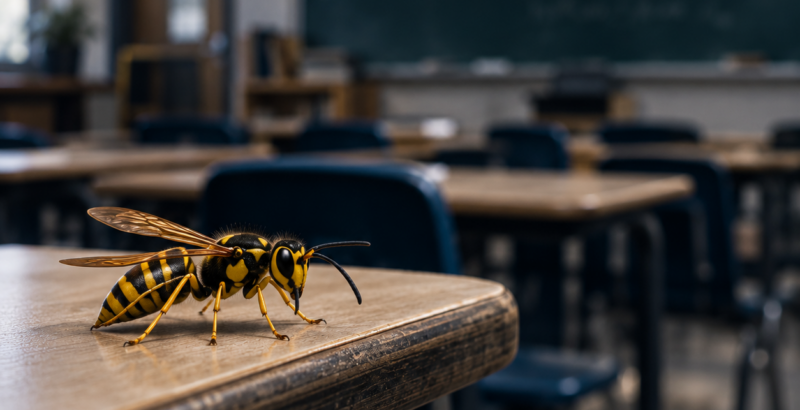
A classroom full of yellowjackets.
Students reportedly being stung while sitting at their desks.
Maintenance pulled ceiling tiles. They removed the lenses from light fixtures. They went up on the roof. They checked the HVAC ducts.
No nest.
Meanwhile, the classroom itself offered plenty of evidence that something was going on. Multiple half-full cans of soda. Pizza boxes left after an end-of-year party.
And, of course, yellowjackets.
The problem wasn’t finding the insects.
The problem was finding where they were coming from.
The search that came up empty
This happened at a Washington school district, and the maintenance team had already done what most people would probably do.
Look where the insects are.
Check above the ceiling. Check the lights. Check the roof. Check the ducts.
All reasonable possibilities.
None of them contained the nest.
When Sprague’s Route Manager inspected the classroom, another detail emerged: the yellowjackets were gaining access from behind an electrical junction box.
The nest was in the wall.
And outside the building?
The entrance wasn’t a giant hole, a hanging nest or anything else that screamed YELLOWJACKETS LIVE HERE.
It was an opening not much bigger than the diameter of a pencil.
Exhibit A: A pencil
That’s worth thinking about.
Inside: a classroom full of activity.
Outside: an opening about the width of a pencil.
The scale of visible pest activity and the size of an entry point can be very different things.
And that’s important whether you’re responsible for a food facility, office campus, restaurant, warehouse, retail property, school or another complex facility.
The place people notice stinging insect activity isn’t necessarily the place that activity originates.
A dumpster may be where they’re feeding.
An entrance may be where employees encounter them.
An outdoor seating area may be where complaints start.
A loading dock may be where someone notices the activity.
Those observations matter.
But they’re the beginning of the investigation, not necessarily the end.
Exhibit B: The trap
Years before the classroom case study, Sprague’s Jeremy Hundley shared another yellowjacket observation with employees.
His advice was simple:
“Keep an eye out.”
A yellowjacket nest entrance was right next to a trap.
It’s almost comically on-the-nose for a pest-control company.
The nest entrance was beside the trap.
It’s a simple field observation, but a useful one: good pest management depends on more than what’s captured in a device. It also depends on paying attention to what’s happening around it.
Where is activity showing up?
Where else is activity showing up?
What conditions are present nearby?
Sometimes a small observation can change where the investigation goes next.
Your team may already have the next clue
That’s where the people who know a facility best become particularly valuable.
A Route Manager sees your property during service visits.
Your employees see it every day.
For example, someone on the loading dock may notice yellowjackets consistently heading toward one section of the building.
A maintenance employee may notice activity around an area where work was recently completed.
Someone emptying waste may notice that activity seems heavier at a particular time of day.
An employee may simply say:
“They always seem to come from over there.”
None of those people need to identify the species or find the nest themselves.
They’ve contributed useful information.
They noticed a pattern.
When stinging insect activity continues or returns, those observations can give your pest management team additional information to investigate.
Instead of only reporting, “We’re seeing yellowjackets again,” details such as where, when and what changed can help build a better picture of what’s happening.
What a Route Manager notices
Sprague’s current approach emphasizes identifying what’s active and evaluating the conditions around that activity.
Depending on the situation, that can include looking at potential entry and exit points, structural areas, voids and possible nesting locations — and observing flight activity when it may help identify where the activity originates.
In practice, that can mean asking questions like:
You see: yellowjackets around the dumpster.
A Route Manager asks: could the activity be coming from somewhere else?
You see: activity around an employee entrance.
A Route Manager asks: is this the source, or simply where we’re noticing it?
You see: a tiny opening in a structure.
A Route Manager sees: something worth investigating.
You see: a trap.
A Route Manager looks at: what’s happening around it.
The customer brings knowledge of the facility.
The Route Manager brings pest knowledge and an investigative eye.
Put those two things together, and a complaint becomes a clue.
Exhibit C: Evidence tampering
Of course, sometimes someone else gets to the evidence first.
In 2019, Sprague Technical Director Ashley Roden shared a field discovery with employees after she and Nancy Leshley came across a yellowjacket nest that had been dug up.
Ashley identified a possible suspect:
“raccoon (maybe).”
She added:
“I have seen skunks do this too.”
So, for the case file:
Evidence: Yellowjacket nest
Condition: Excavated
Suspect: Raccoon, allegedly
No charges were filed.
It’s a funny field moment, but it illustrates something bigger.
Facilities aren’t static environments.
People move through them. Deliveries arrive. Waste accumulates and gets removed. Landscaping changes. Repairs happen. Doors open and close. Weather shifts. Wildlife passes through.
Changes in site conditions can influence where pest activity appears and how it is investigated.
Sometimes the clue is a pencil-sized opening.
Sometimes it’s right beside the equipment.
And in this case, Ashley suspected a raccoon may have gotten to the evidence first.
When the activity keeps coming back
Seeing another yellowjacket does not, by itself, explain where it came from or whether a nest is nearby.
But repeated activity is worth documenting.
If stinging insects continue showing up around the same part of a property, that’s worth sharing with your pest management team.
Rather than treating each report as an isolated observation, look for the pattern:
Where are you seeing them?
When does the activity seem strongest?
Where do they appear to go?
Has anything around that area changed?
Is this the same place activity was reported before?
You don’t have to solve the case.
Those details simply give the people investigating it more information to evaluate.
The case of the missing nest
Back in that Washington classroom, the answer ultimately wasn’t in any of the places maintenance had searched.
Not the ceiling tiles.
Not the light fixtures.
Not the roof.
Not the HVAC ducts.
The nest was in the wall.
And the opening connecting that indoor activity to the outside was not much bigger than the diameter of a pencil.
That’s why the next time someone at your facility says, “We’re seeing them again,” it may be worth asking one more question:
What else are we noticing?
Because seeing the insect is the first clue, not the last one.
Seeing stinging insect activity at your facility?
Already a Sprague customer? Share what you’re noticing with your Route Manager or Sprague team — where activity is occurring, when you’re seeing it and anything that may have changed. Those observations may help with the investigation.
Not working with Sprague? Learn more about our approach to stinging insect identification and management and how we investigate activity at commercial facilities.