
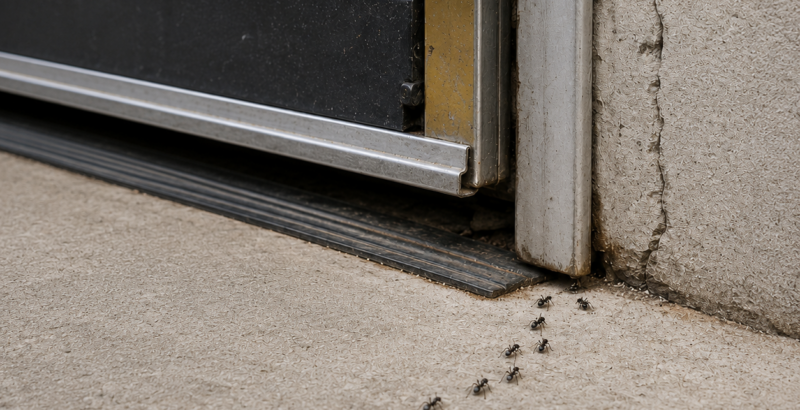
On Monday, there were a few ants near the break room sink. Nobody thought much of it. By Thursday, there was a thin, well-defined trail running across the loading dock floor, and the questions started: What happened? What did we miss? Did the treatment stop working?
It usually didn’t.
More often, nothing new happened at all. In many facilities, activity like this isn’t actually new – it simply hasn’t been noticed yet. As a colony quietly expands, more workers search out food and moisture, and a trail across the floor is usually the first time anyone notices what was already there.
As warm-season conditions set in, ant colonies in commercial facilities that were relatively quiet through the cooler months begin expanding. Worker ants range farther and forage more aggressively, searching out food and moisture to support that growth. That’s the part almost everyone sees: a few ants, then more, then a line of them moving with obvious purpose.
What almost nobody sees is the colony itself. Every ant crossing that dock floor is a worker – a forager – and workers make up only a small share of the colony they belong to. A visible trail is evidence that foraging picked up. It isn’t a measurement of how big the colony has become, and it isn’t proof that anything failed.
A visible trail doesn’t necessarily mean an expanding ant infestation. More often, it means a growing colony has found conditions worth returning to.
Here’s the part worth sitting with: a growing colony doesn’t create a facility problem. It exposes one that was already there.
The trail isn’t just showing where the ants are. It’s showing what they found.
In food manufacturing, distribution, and other commercial facilities, conditions like these can turn into recurring callbacks, audit findings, and customer concerns – along with the operational risk and added labor of solving the same problem more than once.
A trail across a warehouse floor is one of the more common forms of recurring commercial ant activity, and it usually traces back to something the facility has been living with for a while, unnoticed because nothing had drawn attention to it yet. A few examples show up again and again:
A crack in the concrete slab or floor – one of the more common entry points Sprague’s teams see in commercial facilities – or a gap around a dock door or utility penetration, now serving as an entry point once foraging activity increases.
A slow leak, a condensation line, or a spill that doesn’t get cleaned up right away – not enough to notice on its own, but enough to be worth finding once ants start showing up nearby.
Landscaping or mulch pushed up against the foundation, which can hold both moisture and cover right where a building meets the ground.
None of these are new events. They’re existing conditions that a growing colony happened to find first – which is why experienced commercial pest management starts by understanding the condition before changing the treatment.
This is where the useful question changes. “How do we get rid of the ants?” is a reasonable place to start, but it isn’t the question that actually helps a facility. Effective commercial ant control starts with understanding why ants are returning, not simply treating where they’re seen. The more useful one is: what changed?
Is this activity in the same spot as before, or somewhere new? Has anything nearby shifted recently – a mulch delivery, an irrigation schedule, a spill that sat longer than it should have, a door that’s been propped for deliveries? An experienced Sprague Route Manager walking that same floor every visit isn’t just counting ants. They’re comparing what’s in front of them to what they saw last time – which corner had activity, whether it’s repeating or new, and what’s changed nearby since then. That’s the difference between a single sighting and a trend. That kind of pattern recognition is what separates ongoing commercial pest management from a one-time treatment, and it comes down to a short set of questions at every visit: What changed since we were here last? Is this the same location as before, or somewhere new? What condition allowed this activity in the first place?
Answered honestly, those questions do more for a facility than another round of product ever could – they turn a sighting into evidence, and they point at the condition, not just the symptom, which is why Sprague investigates before recommending a change to the program.
Not every increase in activity means something is wrong, and it helps to know the difference.
Some increase in visible activity right after treatment is expected. Ant treatments work by having workers carry pesticide back into the colony, and depending on the species and the size of the colony, full elimination can take up to two weeks. Seeing ants during that window isn’t a sign that anything failed – it can be a sign that the process is working as intended.
What deserves a closer look is different: activity that keeps climbing well past that window, activity that shows up somewhere unrelated to where service was performed, or the same location generating activity again and again despite repeated treatment. That pattern is worth investigating rather than simply retreating, because it usually means there’s still an unresolved condition nearby – and no amount of reapplying product will fix a condition that keeps drawing ants back to it. Long-term ant prevention depends on correcting the conditions attracting ants in the first place, not simply treating the ants themselves.
A trail across the floor is rarely a sign that something just broke. More often, it’s a sign that something was already there, and a growing colony simply made it impossible to keep ignoring.
Recurring ant activity isn’t a pest problem repeating itself. It’s operational feedback that hasn’t been fully heard yet.
The habit worth building isn’t checking for ants more often. It’s noticing what’s changed around the places they show up – and asking that question before assuming the program isn’t working.
Many facilities already have ant activity long before anyone realizes it – the visible trail isn’t always the beginning of the problem, it’s often the first visible evidence of one. If activity keeps returning to the same wall, corner, or entry point, ask your Route Manager to investigate the conditions behind the pattern – not just the trail itself. That’s how long-term risk gets reduced.